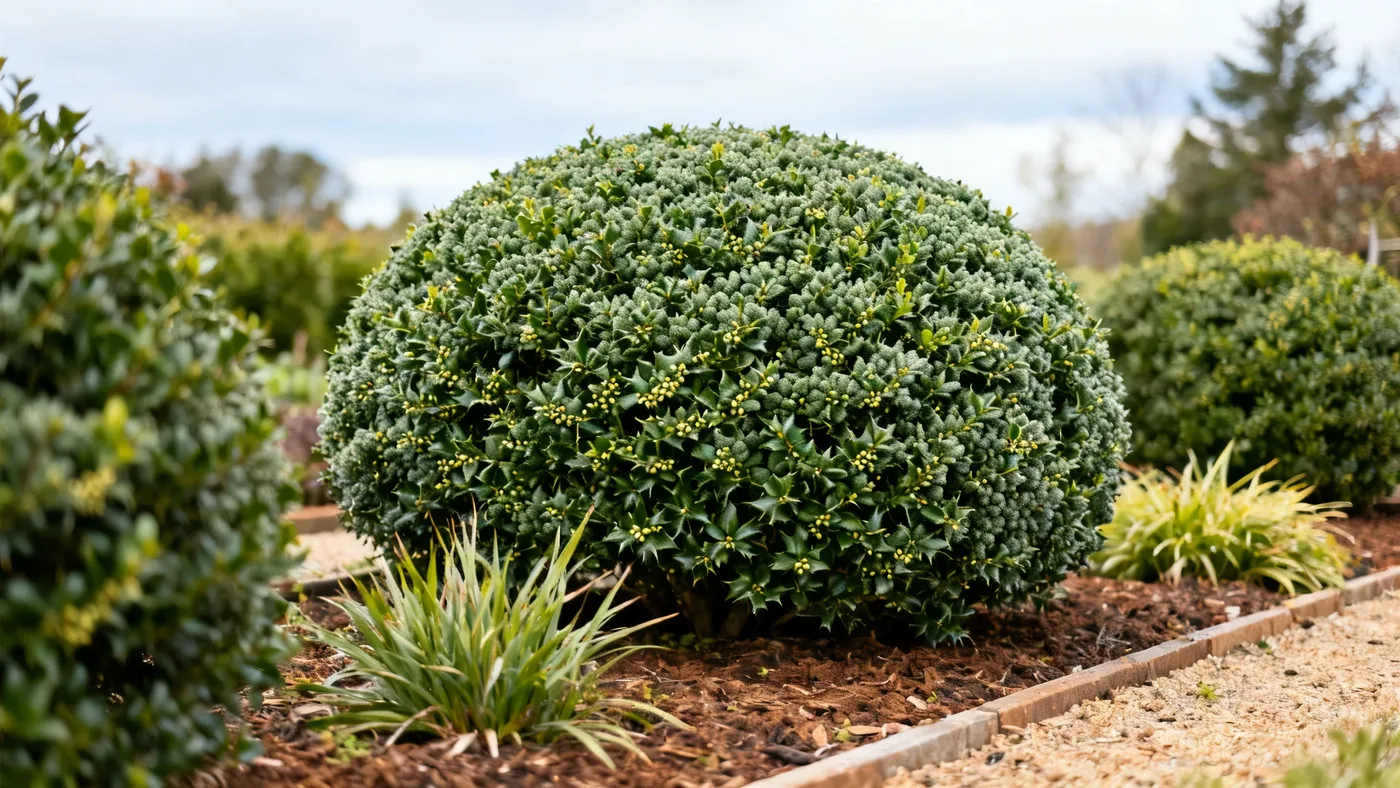
Soft Touch Japanese Holly Spacing for Hedges and Borders
Getting the spacing right when you plant Soft Touch Japanese Holly is one of those details that determines whether your hedge fills in densely or looks sparse for years. Most home gardeners guess at distance, then end up frustrated when their plants reach maturity and either crowd each other or leave noticeable gaps. This guide walks you through the exact spacing standards that nurseries use, why those distances matter, and how to measure and plant so your Soft Touch Holly hedge or mass planting develops exactly as you intend.
Why Soft Touch Holly Spacing Matters
Soft Touch Japanese Holly grows slowly, roughly 3 to 6 inches per year, and matures to a width of 3 to 4 feet. That width measurement is your starting point for every spacing decision. If you space plants too far apart, each shrub stays isolated and you never get the unified, filled hedge you want. If you space them too close, they compete for water and nutrients, develop weak growth, and require aggressive pruning to prevent crowding.
The sweet spot for soft touch holly spacing, whether you are building a low hedge, creating a border, or mass planting for a foundation bed, is 2.5 to 3 feet between the center points of adjacent plants. This distance is grounded in the plant's mature width and accounts for the species' slow growth habit. At this spacing, your young plants will touch and interlock once they reach full size, creating a dense, unified form without the pressure of overcrowding in their early years.
Materials and Tools You Will Need
- Measuring tape or cloth ruler (at least 6 feet long)
- Landscape marking flags or chalk
- Spade or garden fork for soil preparation
- Soil amendment such as peat moss, compost, or aged bark
- Soft Touch Japanese Holly plants in #1 or #3 containers
- Watering can or hose with gentle spray
- Garden gloves
- pH testing kit (optional; target range is 5.0 to 6.5)
Step-by-Step Planting and Spacing Instructions
Step 1: Choose Your Planting Season and Site
Plant Soft Touch Japanese Holly in spring or fall, avoiding the heat of peak summer and hard winter freezes. The plant thrives in full sun to part shade, though it develops best foliage density in part shade during hot climates. Test your soil pH before planting. Soft Touch Holly performs best in acidic to slightly acidic soil between 5.0 and 6.5. If your soil is alkaline, amend it with sulfur or peat moss several weeks before planting.
Step 2: Mark Your Planting Line and Center Points
Lay out the hedge or border line using a garden hose or chalk line. This is your visual reference. Using your measuring tape, mark the center point of each planting hole at 2.5-foot intervals along the line. For a hedgerow running 15 feet, for example, you would mark points at 0 feet, 2.5 feet, 5 feet, 7.5 feet, 10 feet, 12.5 feet, and 15 feet. Place landscape flags or chalk marks at each center point. Step back and look at your marks. They should form a straight line with equal spacing between each point.
Step 3: Dig Planting Holes to the Right Depth and Width
At each marked center point, dig a hole as deep as the root ball of your Soft Touch Holly and 1.5 times as wide. For a plant in a #1 container (roughly 10 inches wide), your hole might be 10 inches deep and 15 inches wide. For a #3 container (roughly 14 inches wide), dig 14 inches deep and 21 inches wide. The goal is a hole wide enough that you can spread the roots slightly without crowding, and deep enough that the top of the root ball sits level with the soil surface after planting. Never plant deeper; this causes root rot.
Step 4: Amend Soil and Set Each Plant
Mix the native soil removed from each hole with peat moss, compost, or aged bark at a ratio of about two parts soil to one part amendment. This creates the moist, well-drained, humus-rich planting medium Soft Touch Holly prefers. Place a few inches of amended soil at the bottom of each hole, then set the plant so its root ball rests at the proper depth. Backfill with amended soil, firming gently as you work, until the hole is full and level with the surrounding grade.
Step 5: Create a Water Basin and Water Thoroughly
After backfilling, create a 3 to 4-inch-tall basin of soil around the perimeter of the hole, about 2 to 3 feet from the plant's center. This basin catches water and directs it down into the root zone rather than allowing it to run off. Water each plant deeply so that water soaks at least 8 to 10 inches into the soil. The plant's roots and the amended soil around it need thorough saturation at planting time.
Step 6: Apply Mulch and Maintain Moisture
Spread a 2 to 3-inch layer of mulch (aged bark or wood chips) over the root zone of each plant, keeping mulch a few inches away from the stem to prevent rot. Mulch helps retain moisture and keeps the soil cool during establishment. For the first 1 to 2 years, water during dry spells to maintain consistent soil moisture. Soft Touch Holly is not as drought tolerant compared to true drought-tough shrubs, so supplemental water during the establishment phase matters.
Soft Touch Holly Hedge Spacing Guidelines by Use
Low Hedge Spacing
If your goal is a low, uniform hedge that edges a garden bed or defines a pathway, stick to 2.5 to 3 feet center-to-center spacing. Plant in a single row along your marked line. At maturity, these plants will reach 2 to 3 feet tall and 3 to 4 feet wide, filling in to create a dense, mounded form. Light shearing in late winter or early spring keeps the hedge tidy, though Soft Touch Holly's naturally mounding shape means minimal pruning is needed to maintain its form.
Border and Foundation Planting
For a tiered border against a building or foundation planting, use 2.5 to 3 feet spacing if you are planting in a single row directly against the wall. If you want a deeper, fuller border with multiple rows, plant a back row at 2.5 to 3 feet spacing and a front row offset so that front-row plants nestle into the gaps of the back row, also at 2.5 to 3 feet spacing within the front row itself. This staggered pattern creates a fuller appearance than a rigid grid.
Soft Touch Holly Mass Planting Distance
Mass planting means several Soft Touch Japanese Holly plants grouped in a bed without a formal hedge line. Use the same 2.5 to 3-foot spacing within each row and between rows. Space plants in offset rows so that the pattern is staggered, which encourages a fuller, more natural appearance. At this spacing, a mass planting of 9 plants arranged in a 3-by-3 staggered pattern occupies roughly a 9-by-9-foot area at maturity.
Tips for Success with Holly Spacing
- Measure twice. Before digging, double-check your spacing marks with your tape. A few minutes now prevents hours of regret later.
- Check soil pH early. Chlorosis (yellowing foliage in alkaline soil) is avoidable if you amend before planting. Do not wait until plants are stressed.
- Water consistently the first season. Even though Soft Touch Holly is evergreen, it needs steady moisture as its roots establish. Dry spells in the first year can set growth back months.
- Do not fertilize at planting. Fresh compost or peat in your planting hole provides nutrients for the first season. Hold off on fertilizer until the following spring, then apply a light feeding of acid-forming, slow-release shrub fertilizer in early spring.
- Plan for light pruning only. Soft Touch Holly does not demand heavy pruning to maintain shape. Light shearing in late winter or early spring before new growth keeps it tidy. Resist the urge to shear it into unnatural forms; its mounding habit is part of its appeal.
Common Spacing Mistakes to Avoid
- Planting too close. Spacing plants closer than 2.5 feet to encourage a faster-filled hedge often backfires. Root competition stresses the plants, and you end up spending years pruning to prevent overcrowding rather than enjoying a naturally full form.
- Planting too far apart. Spacing plants more than 3 feet apart leaves noticeable gaps that take many years to fill. At 3 to 6 inches of growth per year, a 6-inch gap between mature plants means 1 to 2 years of visual awkwardness.
- Ignoring soil prep. Soft Touch Holly prefers moist, well-drained, humus-rich soil. Planting in raw clay or compacted soil and hoping the plant will adapt leads to root rot or stunted growth. Amend your soil.
- Planting too deep. The top of the root ball should sit level with the soil surface, not buried an inch or two below. Deep planting invites root rot and slows establishment.
- Neglecting first-season water. The first year of supplemental water in dry spells is an investment in vigorous growth. Soft Touch Holly is not drought tolerant compared to true drought-tough shrubs.
What to Expect After Planting
In the first season after planting, Soft Touch Japanese Holly will focus on root establishment rather than showy top growth. You may see modest new foliage in late spring and early summer, but growth is slow. This is normal. By year 2, root systems are more established, and growth accelerates slightly. By year 3 to 5, plants begin to fill the gaps between them, and your hedge or mass planting starts to read as a unified form rather than individual shrubs.
At 2.5 to 3-foot spacing, plants typically touch and interlock by year 4 or 5, creating the dense, mounded appearance you want. This timeline assumes consistent moisture, acidic soil, and minimal stress. Poor site conditions or prolonged drought will extend it. Once established, your Soft Touch Holly hedge will require light maintenance: a simple shearing in late winter or early spring before new growth, and the occasional deep watering during extended dry spells.
For more detailed guidance on ongoing care after your hedge is established, visit our Soft Touch Japanese Holly care guide.
Quick Reference: Spacing and Planting Checklist
| Task or Measurement | Specification |
|---|---|
| Center-to-center spacing | 2.5 to 3 feet |
| Planting season | Spring or fall |
| Hole depth | Match root ball depth |
| Hole width | 1.5 times the root ball width |
| Soil amendment ratio | 2 parts native soil to 1 part peat/compost/bark |
| Target soil pH | 5.0 to 6.5 |
| Mulch depth | 2 to 3 inches |
| Water basin height | 3 to 4 inches |
| Years to fill in (ideal conditions) | 3 to 5 years |
| Mature height at full size | 2 to 3 feet |
| Mature width at full size | 3 to 4 feet |
| Growth rate per year | 3 to 6 inches |
| USDA hardiness zones | 5 to 8 |
| First-year watering | Consistent moisture; supplement during dry spells |
| Pruning timing | Late winter or early spring before new growth, or after early summer growth flush |