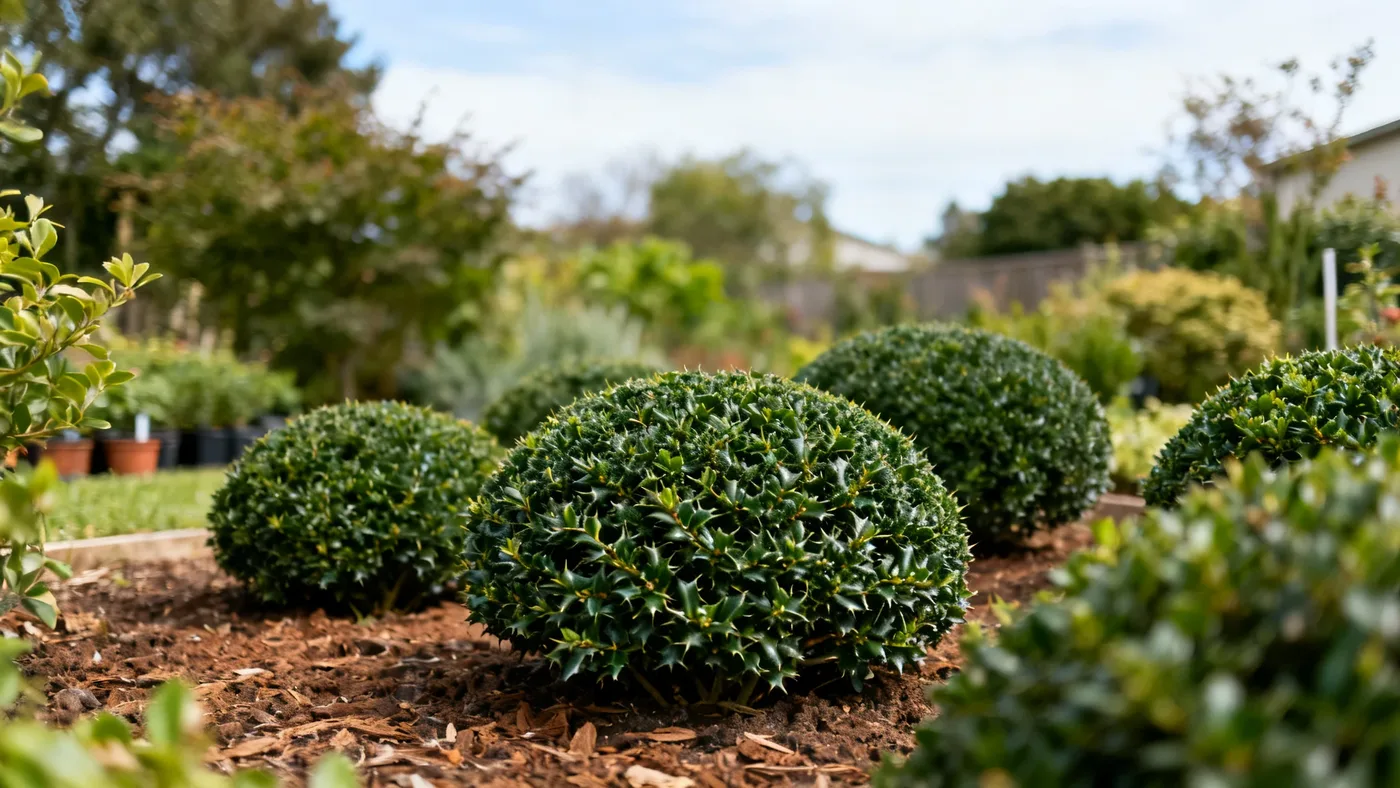
Sun and Light Needs for Soft Touch Japanese Holly
Soft Touch Japanese Holly thrives in full sun to part shade, but the balance between these two shifts based on your zone and climate. Getting this decision right before planting matters because light availability directly affects foliage density, growth rate, and overall health. This guide walks you through assessing your site, choosing the best location, and adjusting care if conditions aren't ideal.
Materials and Setup You'll Need
Before planting, gather these tools to evaluate your site's light:
- A compass or smartphone compass app to identify cardinal directions
- A notebook or phone notes to record light observations at different times
- A watch or phone to time direct sunlight hours
- Knowledge of your USDA hardiness zone (Soft Touch Japanese Holly grows in zones 5 through 8, though zone 8 performance varies with heat and humidity)
- Awareness of nearby structures, trees, or features that cast shadows
Step 1: Assess Your Sunlight Hours
Full sun means 6 or more hours of direct sunlight daily. Part shade means 3 to 5 hours of direct sun, or dappled sun all day. Soft Touch Japanese Holly performs well in either, but you need to know what your site offers.
Pick a day when weather is clear and there is no cloud cover. Starting at sunrise, check your planting location every hour until sunset. Note when direct sun hits the spot and when it falls into shadow from nearby trees, fences, or buildings. Write down the total hours of direct sun the area receives. Repeat this observation on a second day to confirm your count.
This single step determines whether your site suits full sun planting or would be better as part shade. Do not skip it, even if you think you know your yard well. Shadows shift as the sun moves through seasons.
Step 2: Check Your Climate Zone and Summer Heat
Your USDA zone and local summer temperatures influence whether Soft Touch Holly prefers more sun or more shade.
In zones 5 through 7, Soft Touch Japanese Holly thrives in full sun (6+ hours daily) and produces the densest foliage. If you live in zone 8, check your typical summer high temperatures and humidity levels. Zone 8 performance is variable, and the plant actually achieves better foliage density in part shade if your area experiences sustained heat above 85°F or high humidity. In warmer climates, afternoon shade protects the leaves from stress.
If you are unsure of your zone, check your local extension service. The zone number is printed on plant tags at most nurseries and is available online through the USDA zone finder.
Step 3: Identify Candidate Planting Locations
Using your sunlight hour count, list 2 to 3 possible planting spots:
- A location in full sun (6+ hours daily), south or west facing
- A location in part shade (3 to 5 hours daily), ideally with morning sun and afternoon shade
- A spot under high-canopy trees that provide dappled light all day
For each location, note the soil condition as well. Soft Touch Japanese Holly needs moist, well-drained, humus-rich soil with an acidic to slightly acidic pH around 5.0 to 6.5. If soil drains too quickly or stays waterlogged, light exposure alone won't save the plant. See the complete care guide for soil preparation steps.
Step 4: Choose Your Final Location Based on Light and Heat
Make your decision using this simple framework:
If you are in zones 5 to 7: Plant in full sun if your soil drains well. Full sun sites produce the most attractive, densest foliage. If you choose part shade, the plant will still grow, but it may be slightly more open and slow to fill in. Soft Touch Japanese Holly grows roughly 3 to 6 inches per year, so patience is already built into its schedule.
If you are in zone 8: If summer heat regularly exceeds 85°F or humidity stays high, choose part shade, especially afternoon shade. Morning sun with afternoon protection from trees or a structure creates ideal conditions. Full sun is possible if you provide consistent supplemental water during dry spells, but part shade reduces stress and watering needs.
Choose part shade as well if your site has alkaline soil (pH above 7), because the plant may develop chlorosis (yellowing leaves with green veins) in high-pH, high-light conditions. Shade stress is easier to manage than soil chemistry.
Step 5: Account for Seasonal Light Shifts
The sun's angle changes throughout the year. A spot that receives 6 hours of sun in June may get only 3 hours in December due to tree canopy or building shadows.
If your site is borderline (around 4 to 6 hours), autumn and winter light will dip below your summer measurement. Plan for this. Soft Touch Japanese Holly maintains dense green foliage year-round as long as it established well during the growing season. If you planted in a borderline-light spot, check growth density after the first winter. If growth slows significantly, consider relocating the plant in early spring or increasing water and fertilizer to compensate.
Most home gardeners who plant Soft Touch Japanese Holly in part shade in spring report good growth by their second summer, even though winter light is lower.
Step 6: Adjust Care if Light Is Less Than Ideal
If your final location receives less direct sun than you'd prefer, these adjustments help:
- Increase water consistency: Part-shade plants dry out less quickly, but soil should still stay moist (not soggy). Check soil 1 to 2 inches down before watering in dry spells, especially the first 1 to 2 years after planting.
- Fertilize lightly in early spring: Use an acid-forming, slow-release holly or shrub fertilizer. Follow package rates; avoid over-fertilizing, which can cause weak, leggy growth in lower light.
- Prune minimally: Let the plant's natural mounding form develop. In shadier locations, limit pruning to remove dead branches or very wayward stems. Frequent pruning removes foliage the plant needs to photosynthesize in low light.
Conversely, if you planted in full sun and notice yellowing or leaf scorch in zone 8 summers, shift to a spot that receives afternoon shade, or install a 30-percent shade cloth from June through September.
Common Light-Related Mistakes to Avoid
Overestimating shade under trees: Dappled shade under high-canopy trees (oaks, maples, pines) is often clearer than you expect. These rarely block 6+ hours of daily sun. If you want deeper shade, choose a spot east of a building (morning sun, afternoon shadow) rather than under a tree.
Planting too close to south-facing walls: In zones 7 and 8, full sun against a south or west wall can scorch leaves in midsummer. A small offset (18 to 24 inches away) allows better air movement and slightly cooler conditions.
Ignoring winter sun angles: A spot in full sun in July may be shaded by a fence or building in December. This rarely kills Soft Touch Japanese Holly, but dense growth may thin if winter light is too low for several years in a row.
Assuming all part shade is equal: Morning sun with afternoon shade is better than all-day dappled shade, because morning sun warms and dries dew from foliage, reducing disease risk.
Expected Results After 1 to 2 Years
Once established, Soft Touch Japanese Holly in the right light for your zone will exhibit these signs of health:
- Dense, fine-textured dark green foliage with no visible bare branches inside the canopy
- Steady growth of roughly 3 to 6 inches per year (full sun and good soil support the upper end)
- A naturally mounded form, typically reaching 2 to 3 feet tall and 3 to 4 feet wide over several years
- No yellowing, scorch marks, or significant leaf drop in summer or winter
Slow growth is normal for this plant. Do not expect rapid size increase in shade; instead, expect steady, reliable development. If growth stops entirely after the first year, light and soil conditions are likely responsible. A soil test and honest reassessment of sunlight hours can identify the cause.
Light Management Quick Reference
| Condition | Sun Exposure | Best For Which Zones? | Expected Density |
|---|---|---|---|
| Full sun (6+ hours daily) | South or west facing | Zones 5-7 | Densest foliage, fastest growth |
| Part shade (3-5 hours) | Morning sun, afternoon shade | All zones; essential for zone 8 heat | Dense foliage, slightly slower growth |
| Dappled shade (high-canopy trees) | Filtered light all day | Zones 5-7 (not ideal for zone 8) | Good foliage if 3+ hours direct sun reaches site |
| Heavy shade (under 3 hours) | North side of buildings or dense shade | Not recommended | Thin, open growth; poor performance |
Checklist: Sun and Light Decision
- ☐ Measured direct sunlight hours at your planting site on two clear days
- ☐ Confirmed your USDA hardiness zone
- ☐ Checked summer temperature and humidity patterns if in zone 8
- ☐ Tested soil pH and drainage at candidate locations
- ☐ Chose a location that matches your zone and sunlight availability
- ☐ Noted seasonal shadow changes from nearby trees or structures
- ☐ Planned water and care adjustments if light is below full sun
- ☐ Marked the final planting spot and scheduled planting for spring or fall